Temporary Cardiac Pacing

OSYPKA Temporary Cardiac Pacing

External pacing systems for immediate stabilization, controlled rhythm management, and real-time clinical feedback.

OSYPKA’s temporary pacing portfolio spans single-, dual-, and bi-ventricular support with transvenous and epicardial compatibility. Each device covers a defined clinical role: from rapid single-chamber stabilization, through AV-synchronized dual-chamber control, to bi-ventricular temporary CRT with programmable AV and VV delay.

  • PACE 101 — Single-chamber pacing with direct control for rapid rhythm stabilization.
  • PACE 203 — Dual-chamber pacing with independent atrial/ventricular control and integrated feedback.
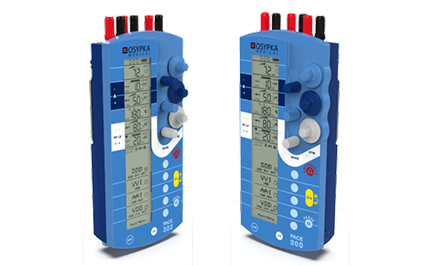
  • PACE 300 — Bi-ventricular temporary pacing with programmable AV/VV delay for complex rhythm management.

Used across emergency, ICU, post-cardiac-surgery, and electrophysiology settings requiring external temporary pacing. Covers single-, dual-, and bi-ventricular pacing with transvenous and epicardial lead compatibility.

PACE 101

Immediate single-chamber pacing with direct control for rapid rhythm stabilization.
Clinical Overview

Acute conduction failure requires immediate pacing without interpretive complexity. PACE 101 provides single-chamber pacing (VVI, AAI, VOO, AOO) with direct adjustment of rate, output, sensitivity, and mode through a four-control interface — enabling rapid stabilization in emergency and early ICU settings.

Key Clinical Benefits
  • Immediate pacing control — Direct adjustment of rate, output, sensitivity, and mode.
  • Single-chamber mode coverage — VVI, AAI, VOO, AOO.
  • Designed for rapid response — Minimizes delay in emergency scenarios.
  • Reliable delivery — Stable performance under high-acuity conditions.
Operational Advantages
  • Compatible with standard transvenous and epicardial temporary pacing leads.
  • Unipolar and bipolar lead compatibility.
  • Compact and portable for ER, ICU, and transport use.
  • Long battery autonomy for continuous pacing.
Clinical Use Context

Used for acute single-chamber temporary pacing in bradyarrhythmia, AV block, and peri-arrest conduction failure. Enables immediate rate, output, sensitivity, and mode control for rapid rhythm stabilization.

Read More

PACE 203

Dual-chamber pacing with real-time feedback for controlled rhythm management.
Clinical Overview

Patients requiring AV synchrony cannot be adequately managed with single-chamber pacing. PACE 203 provides dual-chamber temporary pacing with independent atrial and ventricular parameter control and integrated feedback for sensing, capture, and lead-positioning assessment at the bedside.
Key Clinical Benefits
  • Direct measurement of ICW, ECW, and total body water.
  • Phase angle as a marker of cellular integrity.
  • Body composition (lean mass, fat mass).
  • Repeatable bedside measurement for longitudinal tracking.
What This Enables
  • See distribution, not just balance — Distinguish intravascular, interstitial, and cellular compartments.
  • Identify hidden instability — Detect redistribution and altered hydration not visible clinically.
  • Guide therapy with physiology — Use measurable data to shape fluid and de-resuscitation strategies.
  • Track response over time — Repeatable measurements monitor treatment effect.
Read More

PACE 300

Temporary bi-ventricular pacing with advanced control for complex
rhythm management.
Clinical Overview

Complex cardiac patients may require coordinated ventricular activation and timing optimization that standard pacing cannot provide. PACE 300 delivers bi-ventricular temporary pacing with programmable AV and VV delay, advanced pacing modes, and integrated feedback for sensing, capture, and lead-positioning assessment.

Key Clinical Benefits
  • Direct measurement of ICW, ECW, and total body water.
  • Phase angle as a marker of cellular integrity.
  • Body composition (lean mass, fat mass).
  • Repeatable bedside measurement for longitudinal tracking.
What This Enables
  • See distribution, not just balance — Distinguish intravascular, interstitial, and cellular compartments.
  • Identify hidden instability — Detect redistribution and altered hydration not visible clinically.
  • Guide therapy with physiology — Use measurable data to shape fluid and de-resuscitation strategies.
  • Track response over time — Repeatable measurements monitor treatment effect.
Read More

Connect with our clinical team.

For clinical evaluations, implementation support and product selection guidance..

SEND INQUIRY